

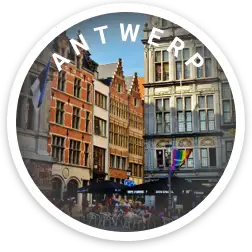
"Diamond Capital of the World"
Photo by hans m.
A giant named Antigoon once lived by the Scheldt River and collected tolls from passing boats. Anyone who refused lost their hand.
A soldier named Silvius Brabo finally killed him, cut off the giant's own hand, and threw it into the river. That legend is where Antwerp gets its name, and you can buy hand-shaped chocolate treats called Antwerpse Handjes all over the city today.
In the 16th century, Antwerp was the richest city in Europe. Its stock exchange, opened in 1531, was the world's first.
Ships from Portugal, England, and the German states crowded its docks. Merchants from across Europe called it the Babylon of Europe for the sheer number of languages heard on its streets.
In November 1576, Spanish soldiers who hadn't been paid in months went on a three-day rampage through the city, killing at least 7,000 people and burning hundreds of buildings. The attack became known as the Spanish Fury.
It was the largest massacre in the history of the Low Countries.
Nine years later, in 1585, Spanish forces besieged and captured the city. All Protestants were given four years to leave. Of Antwerp's 100,000 residents, only 40,000 remained after the exodus.
Most headed north to Amsterdam, taking their skills and money with them. They built what history calls the Dutch Golden Age. Antwerp paid for it.
Peter Paul Rubens, born in 1577, returned to Antwerp after nearly a decade in Italy and spent the rest of his life here. He built himself a mansion modeled on an Italian palazzo and filled it with a studio, a sculpture gallery, and a formal garden.
Four of his largest altarpieces still hang inside the Cathedral of Our Lady, whose 123-meter spire remains the tallest church tower in Belgium.
Today Antwerp handles around 84 percent of the world's rough diamond trade. The diamond district, a few square blocks near the central station, moves around $54 billion in diamonds every year.
Walk the Grote Markt and look up at the 16th-century guild houses ringing the square. Step inside the Cathedral of Our Lady to see the Rubens altarpieces up close.
Visit the Rubenshuis to walk through the Italian palazzo Rubens designed for himself, including his original garden and studio. Tour the Museum aan de Stroom, a stacked tower of glass and red sandstone with panoramic views of the port.
Order moules-frites at a brasserie near the Grote Markt, or pick up a cone of Belgian frites from a frietkot and eat them on the square. Antwerp's chocolate shops line every main street.
Buy a bag of Antwerpse Handjes, the hand-shaped chocolate and biscuit treats sold across the city, which nod to the founding legend of a giant whose hand was cut off and thrown into the Scheldt.


Points Available
| Sticker | 300 XP |
| Trading Card | 100 XP |
| Total | 400 XP |