

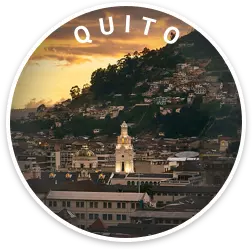
Nestled in the Andes Mountains, Ecuador's capital is recognized as a UNESCO World Heritage Site.
Photo by Pedro Szekely
Quito, the capital city of Ecuador, dates back to long before the arrival of the Spanish conquistadors. The city is situated in a region that was once part of the Inca Empire. Before the Incas, it was inhabited by the Quitu people, giving the city its name. In the early 16th century, Spanish conquistador Sebastián de Belalcázar conquered the area, marking the beginning of Spanish colonial rule.
Throughout the colonial period, Quito flourished as an important center of Spanish power in the Andes. Its historic center, characterized by well-preserved colonial architecture, became a UNESCO World Heritage Site in recognition of its cultural significance.
The 19th century saw Quito's involvement in the struggle for independence from Spanish colonial rule, culminating in the Battle of Pichincha in 1822, which secured Ecuador's freedom.
In the years that followed, Quito underwent significant changes as it became the capital of the newly independent nation of Ecuador. It played a pivotal role in the country's political, economic, and cultural development.
Today, Quito proudly showcases its rich history through its historic churches, monasteries, and plazas. The Basilica del Voto Nacional, with its stunning Gothic architecture, stands as a testament to the city's deep-rooted Catholic heritage. The city's colonial old town, known as "Quito Antiguo," is a labyrinth of narrow cobblestone streets and vibrant squares, where centuries-old churches and museums provide windows into its past.


Points Available
| Sticker | 300 XP |
| Trading Card | 100 XP |
| Total | 400 XP |
Local Airport
Mariscal Sucre International Airport
Elevation
2,400 m
Opened
2013
Runways
1