
Bletchley Park United Kingdom

Learn about the Allied efforts to break the codes Germany used to keep their communications secret.
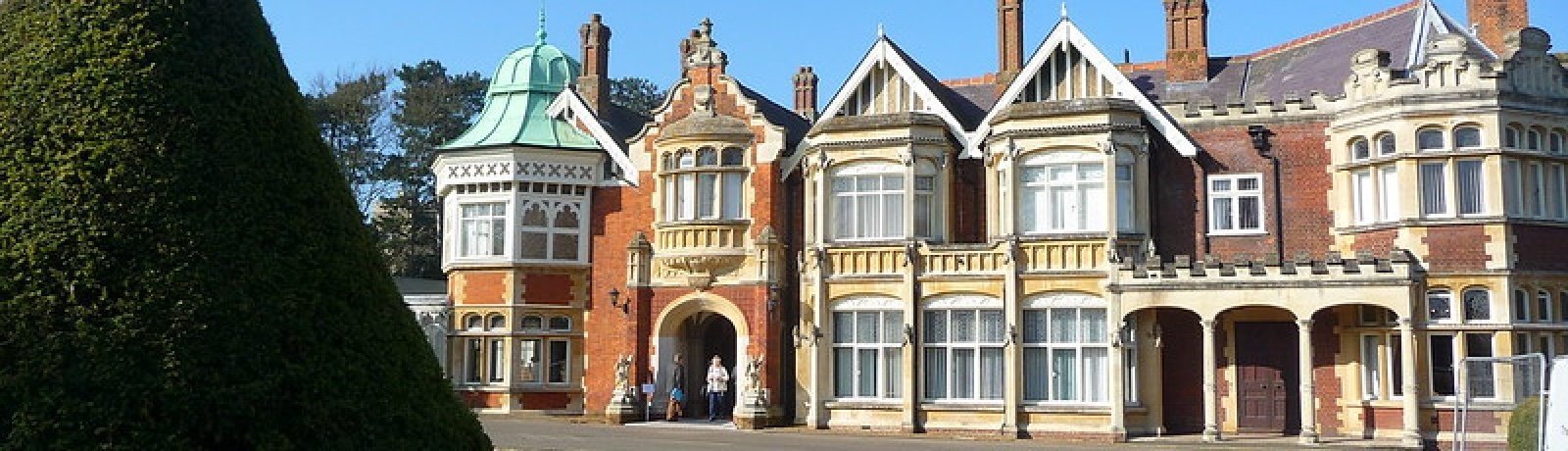
Photo by Neil Thompson
At its busiest, nearly 10,000 people worked at Bletchley Park, and almost nobody outside its gates knew what any of them actually did. For decades after World War II ended, most of them still weren't allowed to talk about it.
Bletchley Park was Britain's top-secret codebreaking headquarters during World War II. Its job was to crack the secret codes Germany used to send military messages, giving the Allies critical information about enemy plans before they happened.
The most famous of these codes came from a machine called Enigma, which scrambled messages into what looked like meaningless letters. A team at Bletchley Park, including the brilliant mathematician Alan Turing, found a way to break it.
Alan Turing was a British mathematician and one of the key minds behind the Enigma breakthrough. He helped design a machine called the Bombe, which sped up the process of testing possible Enigma settings until the code cracked. After the war, Turing became a pioneer in early computer science, and today he's remembered as one of the founders of modern computing.
Bletchley Park's codebreakers didn't stop at Enigma. To crack an even more complex German cipher called Lorenz, engineers built a machine called Colossus, delivered in January 1944. Colossus is considered the world's first large-scale electronic computer, built years before most people had ever imagined such a machine could exist.
At the height of the war, Bletchley Park and its outposts employed close to 10,000 people, and about three-quarters of them were women, many operating the Bombe and Colossus machines around the clock in rotating shifts.
Historians believe the codebreaking done here shortened World War II by as much as two years, potentially saving countless lives.
Walk through the huts where codebreakers once worked in near-total secrecy. See a working reconstruction of the Colossus computer, rebuilt piece by piece using old photographs after the originals were destroyed. Visit the mansion house that once served as headquarters for one of the most important secret operations of the entire war.
Who was Alan Turing?
Alan Turing was a British mathematician, logician, and computer scientist who made significant contributions to the fields of mathematics, computer science, and artificial intelligence. Born on June 23, 1912, in London, Turing is best known for his work during World War II and for being a pioneer in computer science.
During World War II, Turing worked at Bletchley Park, the British codebreaking center. He played a crucial role in breaking the German Enigma code, which was used by the Nazis to send secure military communications. His work in cracking the Enigma code helped the Allies win the war by providing them with critical information about German plans.
After the war, Turing made significant contributions to the development of early computers. He proposed the concept of a "universal machine" that could perform any calculation if given the correct instructions. This idea became the foundation for modern computers. Turing also developed the Turing Test, a method for determining whether a machine can exhibit intelligent behavior equivalent to, or indistinguishable from, that of a human.

EARN UP TO
1,300 XP
at Bletchley Park — collect the stamp, answer the trivia and finish the quests.
Start your travel passportPoints Available
| Stamp | 750 XP |
| Trivia Questions | 300 XP |
| Trading Card | 250 XP |
| Total | 1,300 XP |
Login to customize your picture from Bletchley Park.

Exploring United Kingdom