
Cliffs of Moher Ireland
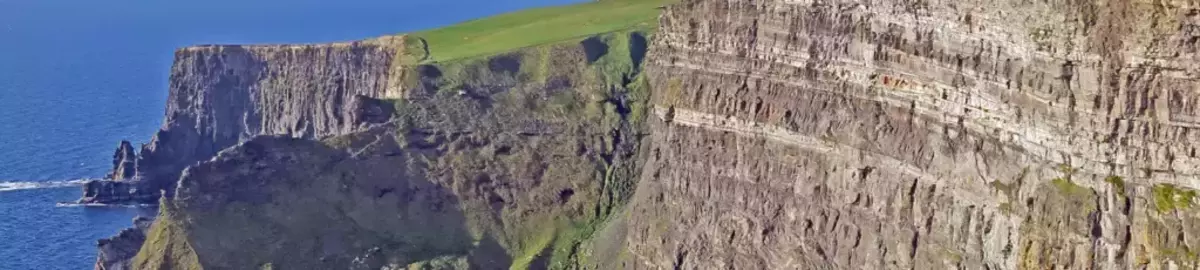

Dramatic cliffs rising along the coast of Ireland.
Photo by Alex Ranaldi
The rock in these cliffs didn't form in Ireland. It formed near the equator, about 6,000 miles south of where it sits today, back when this land was a hot, muddy river delta.
That was roughly 320 million years ago. Rivers dumped sand and mud into a shallow sea, layer after layer, for millions of years.
Those layers hardened into rock. Then the whole slab slowly drifted north to become part of Ireland.
Today the cliffs run 14 kilometers along the Atlantic coast in County Clare. At their highest point, they rise 214 meters straight up from the water, taller than a 60-story building.
Look closely at the cliff face and you can still see the stripes. The harder sandstone sticks out in bands, while the softer rock wears away faster.
The Atlantic keeps chipping away at the base. The cliffs are still changing shape, just very, very slowly.
A stone tower stands at the highest point. A local landowner named Cornelius O'Brien built it in 1835, purely so visitors would have a good place to admire the view.
His idea worked. More than a million people come here every year, making it Ireland's most visited natural attraction.
More than 30,000 seabirds nest on the ledges. Puffins are the crowd favorite, with over 1,400 of them making this the largest puffin colony in Ireland.
Puffins arrive around late March and stay through July. Guillemots, kittiwakes, razorbills, and fulmars nest here too, packed onto ledges that look impossible to stand on.
Climb the spiral staircase inside O'Brien's Tower for the highest view of all. Bring binoculars in late spring to spot puffins with their bright orange beaks. On a clear day, look out toward the Aran Islands sitting in the water to the north.


EARN UP TO
1,100 XP
at Cliffs of Moher — collect the stamp, answer the trivia and finish the quests.
Start your travel passportPoints Available
| Stamp | 600 XP |
| Trivia Questions | 300 XP |
| Trading Card | 200 XP |
| Total | 1,100 XP |
Login to customize your picture from the Cliffs of Moher.

Exploring Ireland