

De Haar Castle Netherlands
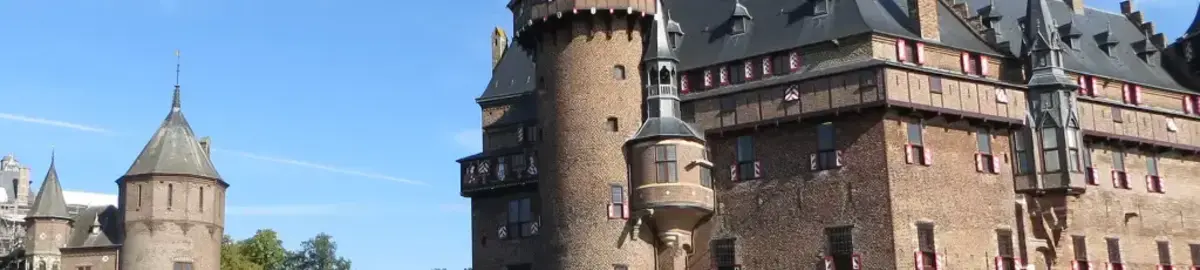
Built by one of Europe's wealthiest families with every fairy-tale detail imaginable.
Photo by Bernt Rostad
To build the park surrounding De Haar Castle, Baron Etienne van Zuylen did something remarkable: he demolished an entire village.
Every house in the medieval village of Haarzuilens was torn down except the church. The 700 residents were moved a kilometer away, where a brand-new village was built for them in a style that matched the castle.
Then the Baron imported 7,000 mature trees from across the Netherlands to fill the empty land.
That level of extravagance tells you everything about what De Haar Castle is.
The original castle on this site dates to 1391, when the De Haar family received the land as a feudal gift. It passed to the Van Zuylen family in 1440, burned down in 1482, was rebuilt, then collapsed into ruins after the last Van Zuylen heir died childless in 1641.
By 1890 it was a crumbling wreck.
That year, Baron Etienne inherited the ruins. Three years earlier he had married Baroness Hélène de Rothschild, and her family's fortune made what came next possible. The Baron hired Pierre Cuypers, the architect who had already designed the Rijksmuseum and Amsterdam Central Station, to rebuild the castle from scratch.
Cuypers worked from 1892 to 1912, building 200 rooms across towers, turrets, and Gothic archways. The result was less a restoration and more a fantasy.
No medieval castle ever actually looked like this. It was a 19th-century vision of what a perfect medieval castle should be, built with 20th-century comforts including electricity, steam heating, a Turkish bath, and a private elevator.
The Rothschild family furnished the interior with tapestries, Japanese porcelain, and paintings from their private collections. The kitchen still holds the largest surviving set of copper pots and pans in the Netherlands, arranged around a six-meter furnace.
In the 1960s the Van Zuylen family hosted guests including Brigitte Bardot, Coco Chanel, and Roger Moore. The family still spends one month a year in the castle today.
Walk the moat, explore the formal gardens modeled on Versailles, and step inside the main hall, which feels more like a cathedral than a castle. Every April the grounds host Elfia, one of Europe's largest fantasy festivals, when thousands of visitors arrive dressed as elves, knights, and steampunk characters.
How do you move 7,000 full-grown trees?
Very slowly, and with a lot of trouble. Planting a normal garden means planting small trees and waiting thirty or forty years for them to grow tall. Baron Etienne did not want to wait, so he had thousands of enormous, already-grown trees dug up somewhere else and carried across the countryside to the castle.
A full-grown tree is one of the heaviest things you can try to move. The roots have to come with it, wrapped in a huge ball of soil, or the tree dies. The story told in Utrecht is that some of the trees were so wide that houses along the route had to be pulled down just to let them pass through the streets.
Nobody has ever proved that part, so treat it as a local legend rather than a fact. What is certain is that the forest you walk through today did not grow there. It was carried there.
Why does De Haar Castle have 30 bathrooms?
Because it was built for guests, and a lot of them. The castle has around 200 rooms and 30 bathrooms, which sounds ordinary until you remember when it was built. In the early 1900s, most families in the Netherlands had no bathroom at all. You washed in a tub in the kitchen and used a toilet outside in the yard.
So while an ordinary Dutch child was carrying buckets of water indoors, a visitor at De Haar could walk down the hall and turn on a tap. The castle was designed so that dozens of guests could stay for weeks at a time without having to wait for the bathroom.
Where did the castle get its electricity?
It made its own. There was no electricity network in the Dutch countryside when De Haar was rebuilt. No power lines ran that far out, so there was nothing to plug into. The first city power stations were only just being built, and villages waited decades longer.
The castle got its own generator on the grounds, making electricity for the building alone. Lights came on inside De Haar while the farmhouses around it still used oil lamps and candles.
Dutch writers say the castle ended up with more comforts than the Dutch royal family had at the time.


EARN UP TO
1,300 XP
at De Haar Castle — collect the stamp, answer the trivia and finish the quests.
Start your travel passportPoints Available
| Stamp | 750 XP |
| Trivia Questions | 300 XP |
| Trading Card | 250 XP |
| Total | 1,300 XP |
Login to customize your picture from De Haar Castle.

Exploring Netherlands
