

Parthenon Greece
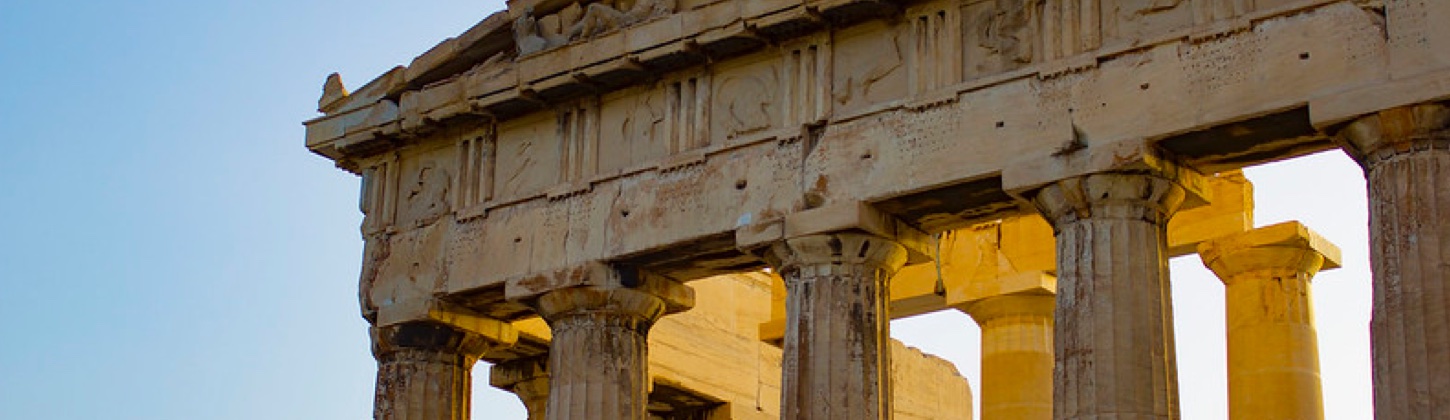

This former temple, completed in 438 BC, was dedicated to the goddess Athena.
Photo by dermuecke
Kid Rating:
The Parthenon stood nearly whole for 2,100 years. Then, on the evening of September 26, 1687, a single Venetian shell crashed through its roof.
The Ottomans were using the temple to store gunpowder. The explosion blew out the middle of the building and killed about 300 people.
It has been a ruin ever since.
The temple went up on the Acropolis, the rocky hill above Athens, between 447 and 432 BC. The Persians had burned an older temple on the spot, and the Athenian leader Pericles wanted to replace it with something that showed off the city's power.
Two architects, Ictinus and Callicrates, designed it. The sculptor Phidias oversaw the decoration, including a giant statue of the goddess Athena inside, made of gold and ivory and standing nearly 12 meters tall.
Athena was the goddess of wisdom and war and the protector of Athens. The temple's name comes from one of her titles, Athena Parthenos, meaning "Athena the maiden."
The building is famous for its tricks. The columns lean slightly inward and bulge in the middle, and the floor curves upward toward the center. The Greeks did this on purpose, because perfectly straight lines look crooked to the human eye from a distance.
The Parthenon didn't stay a temple. Around the 500s AD it became a Christian church, and the statue of Athena disappeared.
The Ottoman Empire conquered Athens in the 1450s and turned it into a mosque in the early 1460s, adding a tall minaret at one corner. It stayed a mosque for more than 200 years, right up to the night of the explosion.
In the early 1800s, a British lord named Elgin got permission from the Ottomans to remove about half the surviving sculptures. They've been in the British Museum in London ever since, and Greece has been asking for them back for decades.
Climb the Acropolis early in the morning, before the heat and the crowds. Stand at the western end, the most complete side, and look for the slight curve in the columns. Then walk down to the Acropolis Museum, where the sculptures still in Athens are displayed with gaps left for the ones in London.


EARN UP TO
1,900 XP
at Parthenon — collect the stamp, answer the trivia and finish the quests.
Start your travel passportPoints Available
| Stamp | 1,200 XP |
| Trivia Questions | 300 XP |
| Trading Card | 400 XP |
| Total | 1,900 XP |
Login to customize your picture from the Parthenon.

Exploring Athens
.webp)

