

Philippines
Discover Philippines
Fun Foods
Chicken Adobo, Lechon, Pancit, Lumpia, Sinigang, Halo-Halo, Leche Flan
On the Philippine island of Bohol lives one of the smallest primates on Earth, the tarsier. It’s about as heavy as an apple, but each of its eyes is roughly as big as its whole brain.
Those huge eyes are stuck in place, so a tarsier can’t roll them. Instead, it swivels its head almost all the way around to look behind itself, like an owl.
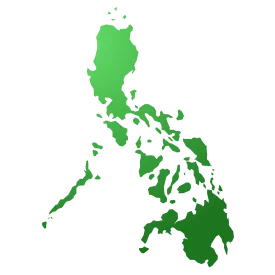
The Philippines is made of 7,641 islands, and only about 2,000 of them have people living on them. Its first people arrived thousands of years ago, sailing between the islands in boats.
In 1521, the explorer Ferdinand Magellan, sailing for Spain, landed in the islands. On the island of Mactan, a chief named Lapu-Lapu refused to bow to the newcomers.
In the battle that followed, Lapu-Lapu’s warriors defeated Magellan’s men, and Magellan himself was killed. Today, Filipinos honor Lapu-Lapu as a national hero.
Spain came back and ruled the islands for more than 300 years, naming them after King Philip II.
Many Filipinos wanted freedom, including a writer and doctor named José Rizal, whose books exposed Spanish abuses. Spain executed him in 1896, and his death helped spark a revolution.
Filipinos declared independence in 1898. But at the end of a war with Spain, the United States bought the islands for 20 million dollars, and Filipinos fought the Americans for their freedom. Many died.
The US ruled for nearly 50 years, and Japan occupied the islands during World War II. The Philippines finally became independent on July 4, 1946.
Later, President Ferdinand Marcos took control in 1972 and ruled as a dictator. In 1986, millions of Filipinos filled the streets in a mostly peaceful uprising called People Power, and Marcos was forced to leave.
For adventures, visit Bohol’s Chocolate Hills, more than a thousand round grassy hills that turn chocolate brown in the dry season. On Palawan, ride a boat into the Puerto Princesa Underground River, where bats hang from the cave ceiling above you.
In the mountains of the north, the Ifugao people carved giant staircases of rice fields into the hills more than 2,000 years ago, and they still farm them today. Get there by jeepney, a colorful bus made from old US Army jeeps.
For food, try lechon, a whole roasted pig with crackly skin, and chicken adobo, simmered in vinegar, soy sauce, and garlic.
For dessert, dig into halo-halo, which means “mix-mix,” a tall glass of shaved ice, milk, sweet beans, and purple yam.
Sources: Philippine Consulate General Chicago: The Philippines History, Google Arts & Culture: Battle of Mactan Mural, and Everything Everywhere: The Seven Wonders of the Philippines.
Experience Points


EARN UP TO
1,250 XP
in Philippines — collect the sticker and the trading card.
Start your travel passportPoints Available
| Sticker | 1,000 XP |
| Trading Card | 250 XP |
| Total | 1,250 XP |

