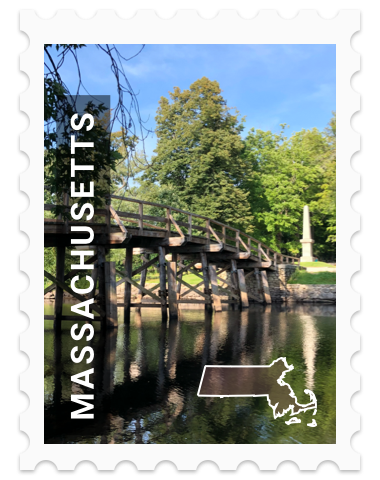

Old North Bridge United States
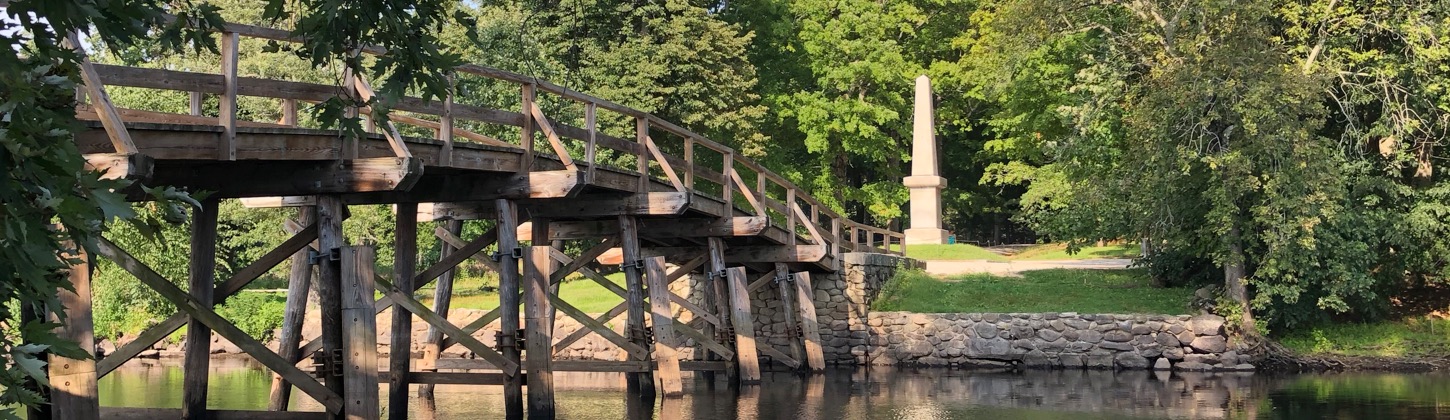
Visit the location where the first shots were fired starting the American Revolution in 1775.
Kid Rating:
Old North Bridge is located in Concord, Massachusetts. This bridge served an important role at the Battle of Concord, one of the first battles of the American Revolutionary War. Although the original bridge is gone, a wooden replica stands in its place today. The bridge is part of Minute Man National Historical Park, which stretches across Concord, Lincoln, and Lexington and is a popular day trip for tourists visiting Boston.
The first day of the American Revolutionary War was on April 19th of 1775. Starting with the Battle of Lexington and leading into the Battle of Concord, the Old North Bridge was where "the shot heard 'round the world" happened. British soldiers fired first, killing two colonial militiamen. Major John Buttrick ordered his men to return fire, and it is that volley the phrase describes. The British retreated back toward the center of Concord. This action was seen as the first steps towards Independence during war time.
The original bridge was taken down in 1793 by the town of Concord because it was no longer usable. A bridge was constructed a few hundred yards away, and the original site sat empty for 82 years until a bridge was returned to it in 1875 for the battle's centennial. Bridges on that spot have been dismantled and rebuilt several times since, and the one standing today dates to 1956 and was extensively rebuilt in 2005. In 1911, a descendant of Major John Buttrick, who led the colonial forces to Old North Bridge during the Revolutionary War, built a mansion overlooking the site of the bridge. Today, that mansion is owned by the National Park Service and features beautiful gardens.
Where does "the shot heard round the world" come from?
From a poem written 62 years after the battle. Nobody said it at the time. In 1837 Concord put up a monument at the bridge, and a local writer named Ralph Waldo Emerson wrote a hymn for the ceremony. One line reads, "Here once the embattled farmers stood, and fired the shot heard round the world."
The phrase means that a short fight between farmers and soldiers at a small wooden bridge ended up mattering far beyond Massachusetts.
Emerson had a family connection to the spot. His grandfather was Concord's minister and lived in a house right next to the bridge. On the morning of the battle the minister watched from his fields, and his wife and children watched from the upstairs windows.
Who is the statue of the farmer with the gun?
He is called The Minute Man. Minutemen were ordinary townspeople who kept a musket by the door and agreed to be ready to fight at a minute's notice. The statue shows him with one hand still on his plough and the other holding his gun.
The sculptor was Daniel Chester French, who was 21 when he got the job. It was his first big commission. Congress gave the project ten old cannons left over from the Civil War, and those cannons were melted down to make the bronze for the statue.
It was unveiled on April 19, 1875, one hundred years to the day after the battle. President Ulysses S. Grant and Emerson both came to see it. French missed his own unveiling, because he had moved to Italy to keep studying sculpture.
Years later he carved the huge seated Abraham Lincoln inside the Lincoln Memorial in Washington.
Who is buried next to the bridge?
Two British soldiers. They were killed in the fighting on April 19, 1775, and the people of Concord buried them near where they fell. Two townsmen named Zechariah Brown and Thomas Davis did the burying.
For almost a hundred years the grave had nothing on it but rough stones. Concord added a proper marker in 1870, and in 1910 put up a second stone carved with lines by the poet James Russell Lowell about men who came three thousand miles from home and died here.
The grave sits just off the path near the bridge.
Who fired first at the Old North Bridge?
The British did. About 400 colonial militia were coming down the hill toward the bridge, and roughly 90 British soldiers were holding it. As the militia got close, a British soldier fired. Most accounts say nobody ordered it, and that it was one frightened, exhausted man pulling the trigger. Two more shots followed, then a full volley.
Two men from the Acton company were killed at the front of the column, Captain Isaac Davis and Abner Hosmer, and four others were wounded.
Major John Buttrick shouted, "Fire, for God's sake, fellow soldiers, fire!" The militia fired back, hit several British soldiers, and the British ran, leaving their wounded behind.
Earlier that same morning at Lexington shots were also exchanged but nobody has ever worked out who fired first there. At the North Bridge the answer is much clearer.


EARN UP TO
750 XP
at Old North Bridge — collect the stamp, answer the trivia and finish the quests.
Start your travel passportPoints Available
| Stamp | 300 XP |
| Trivia Questions | 300 XP |
| Trading Card | 150 XP |
| Total | 750 XP |
Login to customize your picture from the Old North Bridge.
Exploring Massachusetts