


On April 30, 1789, George Washington stood on the balcony of Federal Hall on Wall Street and became the first president of the United States. New York City was the nation's first capital.
The first Congress met there, the Bill of Rights, the set of rules protecting Americans' freedoms, was written there, and the Supreme Court held its first session there. The capital moved to Philadelphia the following year, but New York was already the center of everything.
Long before Europeans arrived, the Haudenosaunee (Iroquois) Confederacy governed this land. Five nations, later six, agreed to work together, settle arguments peacefully, and send leaders to a shared council where every nation had a voice. They'd been doing this for centuries before the U.S. Constitution was written.
The Dutch settled in the 1620s and called their colony New Netherland. The English took it in 1664 and renamed it New York.
About a third of all Revolutionary War battles were fought in New York. The 1777 Battles of Saratoga were the first big American victory that mattered on the world stage. France saw the win and decided to help.
The Revolution split the Haudenosaunee. Some nations sided with the British, others with the Americans. The war destroyed their confederacy and cost them most of their homeland.
In 1825, the Erie Canal opened and changed the country. The 363-mile waterway connected the Hudson River to the Great Lakes, made it far cheaper and faster to move goods, and turned New York City into the busiest port in America.
The canal didn't just carry goods. It carried new ideas. The women's rights movement was born in the canal town of Seneca Falls in 1848.
From 1892 to 1954, more than 12 million immigrants entered the country through Ellis Island. On September 11, 2001, nearly 3,000 people were killed when terrorists attacked the World Trade Center.
You can stand where Washington took the oath at Federal Hall in Lower Manhattan, then walk to the 9/11 Memorial and Museum. Take a ferry to the Statue of Liberty and Ellis Island.
Upstate, hike the Saratoga Battlefield, cruise through a lock on the Erie Canal, or chase waterfalls at Niagara Falls, where 750,000 gallons of water pour over the edge every second.


EARN UP TO
300 XP
in New York — collect the sticker and the trading card.
Start your travel passportMajor Airports
Albany International Airport

Elevation
87 m
Opened
1928
Runways
2
Buffalo Niagara International Airport
Elevation
222 m
Opened
1926
Runways
2
Greater Rochester International Airport
Elevation
170 m
Opened
1920
Runways
3
John F. Kennedy International Airport
Elevation
4 m
Opened
1948
Runways
4
LaGuardia Airport
Elevation
6 m
Opened
1939
Runways
2
Long Island MacArthur Airport
Elevation
30 m
Opened
1949
Runways
3
Syracuse Hancock International Airport
Elevation
128 m
Opened
1949
Runways
2
Westchester County Airport
Elevation
134 m
Opened
1945
Runways
2
Westchester County Airport
Elevation
134 m
Opened
1949
Runways
2
Sticker Collection


African Burial Ground National Monument
A historic monument to the over 400 Africans buried nearby in the 17th century.

American Falls
At 110 feet tall, it's the second of the three waterfalls that make up Niagara Falls.

Central Park
Enjoy the beauty and activities happening at the most visited urban park in the United States.

Chrysler Building
Take in the site of this Art Deco skyscraper that was the world's tallest building in 1930.

Ellis Island
Once the busiest immigration station in the US, almost 12 million migrants arrived through this port.

Empire State Building
The famous skyscraper was the tallest building in the world from 1930 to 1970.

Federal Hall
It was at this location that George Washington was sworn in as the nation’s first president.

Flatiron Building
This steel framed building shaped like an iron was the tallest in New York city in 1902.

Letchworth State Park
Often referred to as the "Grand Canyon of the East" for it's gorges and stunning views.

One World Trade Center
Visit the tallest building in the US that’s part of the rebuilt World Trade Center complex.

September 11th Memorial
A memorial to those killed in the 9/11 attacks and World Trade Center bombing in 1993.

St. Patrick's Cathedral
This Neo Gothic Roman Catholic Cathedral dates back to 1858.

Statue of Liberty
A symbol of freedom, and a welcoming beacon to immigrants arriving to America in the early 1900’s.
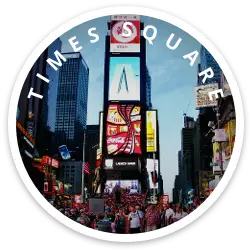
Times Square
Surrounded by billboards and brightly lit advertisements this commercial intersection is a favorite for tourists.

Washington Square Park
Located in Lower Manhattan, it’s one of the best known parks in New York City.